My home town, when I was growing up was Gloucester, located in the west country on the banks of the river Severn, with the Cotswolds to the north, and the Forest of Dean to the west. The estuary of the Severn is five miles from one bank to the other and narrows as it snakes inland for 220 miles. Because of it’s size at the estuary and the way it narrows over a relatively short distance upstream some higher tides a phenomenon known as The Severn Bore, a leading wave that travels rapidly up the river, so powerful that surfers can ride the wave for many miles.
In the late 1960s, a popular pastime that Gloucester locals would partake of was Elver fishing. Elvers are the young of eels and start out on their incredible journey from the Sargasso Sea near Burmuda, swimming the one way trip of 3500 miles towards the Severn estuary, and some other inlets in Europe at a specific time of the year. By the time they reach the Severn they measure 3 to 6 cm in length and have lost their translucent appearance, changing to a more darker white appearance.
Elvers were in abundance in those times, with the big tides on the severn carrying them upstream in the millions. The local fishermen had devised a way of scooping them out of the river at a rate of 100’s every dip, with big home-made square framed nets on a long handle. The fishing mainly took place on the evening tide, partly to avoid having to buy a fishing licence or getting permission from the land owner!
My dad started to make his own elver nets in the late sixties up until the very early seventies. His nets were big, probably measuring a couple of feet in diameter and depth. The handle, typically a piece of 2″by 2″ timber would give a total length of up to seven feet, allowing better control on a slippy and often high river bank.
Dad would check when the tides were at their peak and prepare by packing the Morris Traveller with buckets and other accompanying kit to make for a good night. The nets would be strapped to the roof rack. Mum would wrap us up in warm clothes and make a flask of Bovril to drink during the late hours of the day. Though dad did vary where we went for elvers, his favourite spot was at a small riverbank village called Maisemore, on the outskirts of Gloucester. The river was narrower here and this supposedly gathered the elvers into bigger amounts.
Dad never bothered getting a permit or licence, so there was always an element of risk of being caught poaching, though I don’t recall that ever happening. Over the peak of the high tide, dad would dip the nets off the river bank, wait a few minutes, and carefully lift them out of the water to reveal his catch. The nets consisted of a fine mesh material, usually my mum’s old net curtains that were always popular in those days. Whatever was in the net was carefully tipped into one of the buckets containing a few inches of river water.
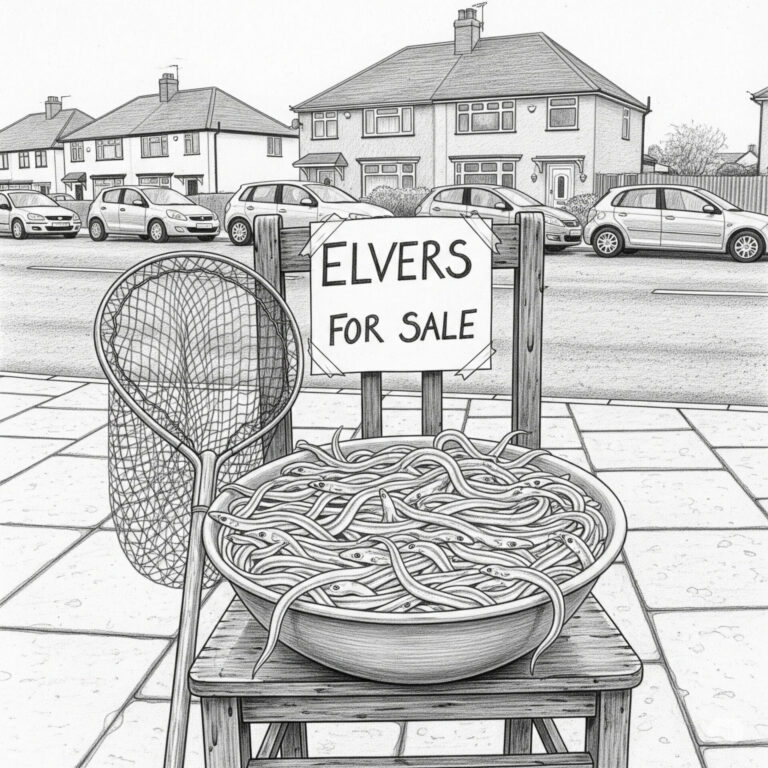
Elvers were a delicious delicacy and popular in the local markets and butchers, selling at one time for as little as three shillings (15p) per pound. Dad did sell some of his catches to the butchers, but there was a more enthusiastic local market for them and fishermen would sell them from home. The tell-tale sign of a house with elvers for sale would be a chair on the roadside, with an elver net leaning on it. Some might have a poster on the chair, stating, “Elvers For Sale“. This annual occurance didn’t last long though. Elver fishing became more popular and big Elver factories (stations) started to appear along the river bank. These were offering the fishermen bigger amounts of money than they could get selling them elsewhere. The stations were exporting the elvers to places such as Japan and asian countries.
So, attracted by the big money on offer from the elver stations, more and more fisherman took to the banks for longer periods of time. The inevitable happened, and over only a few short years elvers all but disappeared from the river. The elver stations vanished, and elver fishing became something of a previous generation pursuit. During this time elver prices soared and prices to this day are still rising. In 2024, a pound of elvers would set you back over £2000.
To be served a plate of elvers was a real treat. But that was not so when my Irish mum, a stranger to the customs of west country life, first cooked them. Dad had not told her what to do with them. So using her own initiative, she carefully topped and tailed each individual elver, something that took her hours to do. Then she boiled them in water for a period of time. When dad came home from work and heard what she’d done with the elvers he laughed at her. First mistake was that the elvers are so tiny, they are cooked whole. Topping and tailing was not necessary and wasteful. Second mistake was boiling them. Elvers are lightly fried in a frying pan with an egg scrambled into the mix and seasoned with salt and plenty of white pepper.
When my mum did cook the elvers the proper way, the taste was like nothing I have ever tasted since. Heavenly, beautiful, delicious, and definitely a little more than special. Sadly, as the elvers went up in price, mum was unable to buy any and fishing them became a difficult task. Guards and patrols were stationed along the river banks and nobody was allowed to fish for elvers.
Elvers were part of my childhood and I would love a plate of them now! I would recommend you go to your favourite search engine and search for a plate of cooked elvers in the image section. Until you’ve tried a plate, you have absolutely no idea how wonderful that flavoursome meal was. Elver fishing is now billed as an illegal act by the UK government and although there are some signs that elvers are returning in decent numbers to the river Severn, getting them out for eating is just not going to happen. Conservation now controls everything associated with this great pastime from my childhood days!
